10,000 Hours of Broken Robots: What the Humanoid Industry Can Learn From Robot Field Service
Humanoid robots are about to meet the same problems every other robot meets in the field, plus a few new ones. Roboworx has spent more than 12,000 field hours keeping service robots, AMRs and kitchen robots running. Most of the time, the problem isn't the robot. It's a restaurant that moved its tables, so the robots can't find their way. It's dust on a LiDAR, so the robot keeps stopping for obstacles that aren't there. It's kitchen grease building up until the emergency stop jams.
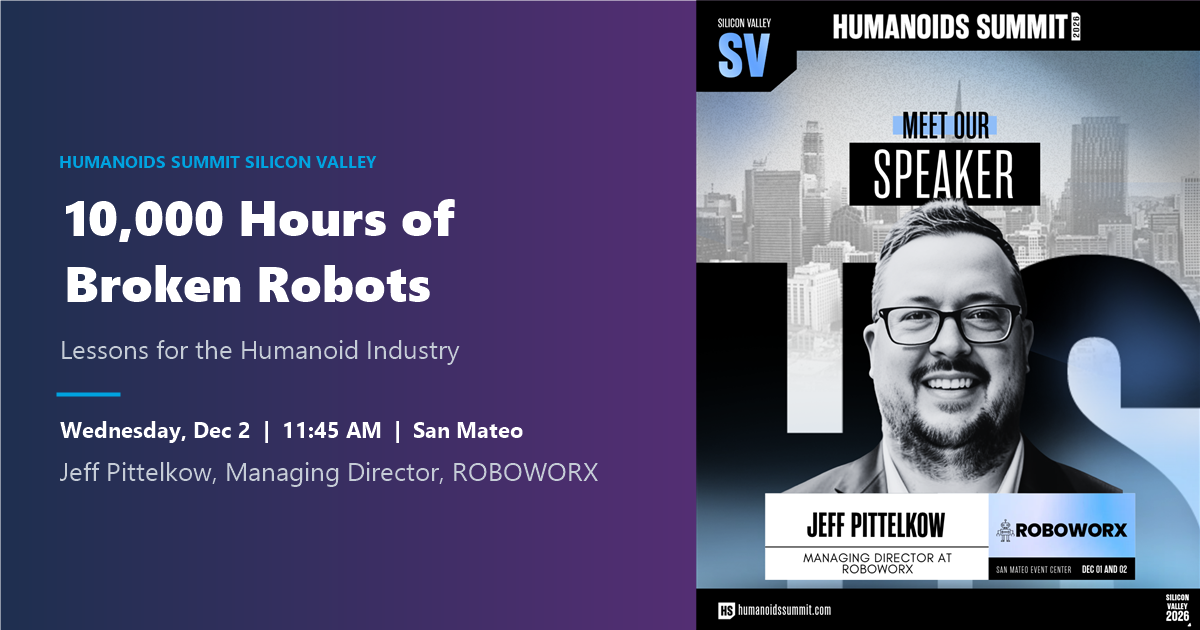
On Wednesday, December 2, Jeff Pittelkow, Managing Director at Roboworx, is sharing what the rest of robotics has already learned the hard way at Humanoids Summit Silicon Valley: "10,000 Hours of Broken Robots: Lessons for the Humanoid Industry." Here is a preview.
The session
- What: 10,000 Hours of Broken Robots: Lessons for the Humanoid Industry
- When: Wednesday, December 2, 2026, 11:45 AM, breakout track
- Where: Humanoids Summit Silicon Valley, San Mateo Event Center
- Who: Jeff Pittelkow, Managing Director, Roboworx
Every robot gets its day on stage
Day one is the demo. Day 400 is when the robot stops at a site where no one ever tested it, at the busiest hour of the week. Who shows up then decides whether the customer buys the next ten robots or sends this one back.
Roboworx has been the one who shows up on almost 1,000 robots across 30 models, in kitchens, dining rooms, warehouses and factory floors. Every one of those visits is logged in Starlight, our service platform, so we know what goes wrong in the field, and how to plan for it before robot number one ships. Humanoids are the next chapter, and the same playbook applies.
Seven lessons from the field
- Most broken robots are not broken. In our Starlight records, more than half of repair visits end with no part replaced. A reset, a lost connection, a dirty sensor, or a user who did not know what normal looks like. Show your customers what normal looks like.
- Don't re-solder the cable. Replace the arm. What actually fails is small: cables, connectors, fuses, charging ports, wheels. Design bigger sub-assemblies that swap fast, and keep them on the shelf.
- The site is part of the robot. Wi-Fi dead zones, new floor mats, grease on the e-stop, a machine powered off mid-cycle. Specify the site the way you specify the robot, and train the people around it.
- A few robots make most of the calls. In Starlight, 10% of the robots we service account for 60% of repair calls. Keep a fault history for every serial number and pull the repeat offender.
- Track usage. It tells you what fails next. The robots that work the most break the most. Count every duty cycle, know when each part is due, and have the stock on hand.
- Service is strategy. Build the organization. A down robot is a lost customer. Technicians near the robots, experts behind them, written procedures, parts where they are needed, and a record of every visit. Decide who shows up before you ship to customers.
- Budget for it. Service costs more than you think. Technicians, travel, training, parts and support. Full-service plans run about 16% to 18% of the robot's price a year. Budget service from the first unit to prevent surprise costs later.
Why humanoids raise the stakes
A humanoid has more joints, more actuators, more cables and more sensors than the robots most fleets run today, and it is meant to work in the busiest places: homes, kitchens, warehouses, hospitals. Every lesson above matters more. The companies that plan service alongside the robot will be the ones whose customers keep buying, and the ones that win.
Frequently asked questions
What can the humanoid industry learn from existing robot fleets?
That most field problems come from the site, the network and the users rather than broken parts; that small parts such as cables and connectors fail most; and that service has to be designed, staffed and budgeted from the first unit.
What is the biggest service mistake in robotics?
Treating service as an afterthought. Full-service plans run about 16% to 18% of a robot's price a year, and that cost has to be in the plan before the first robot ships.
Where is Roboworx speaking at Humanoids Summit 2026?
Jeff Pittelkow presents "10,000 Hours of Broken Robots: Lessons for the Humanoid Industry" on Wednesday, December 2, 2026, at 11:45 AM on the breakout track at Humanoids Summit Silicon Valley, San Mateo Event Center.
Come find us
If you'll be at Humanoids Summit, come find Jeff after the session. If you won't, book a meeting to talk about who shows up on day 400 for your robots.